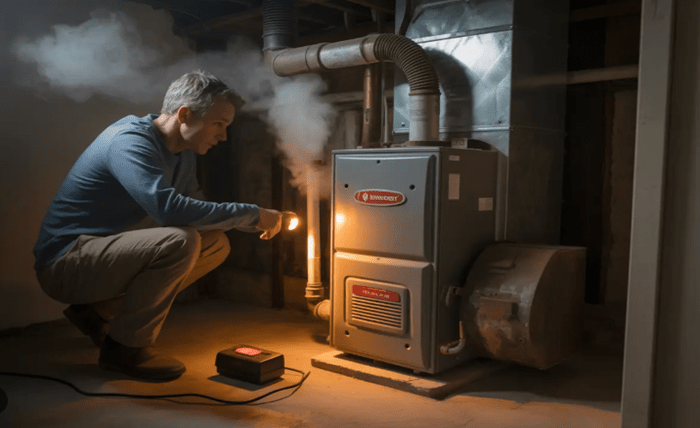
Water around your furnace is not a small maintenance concern. It indicates a malfunction of the system. It can develop rapidly into structural risk and full heating failure. Even worse, electrical risks. That is why you should consider it an emergency.
Knowing the source will assist you in establishing urgency. But any type of leakage needs immediate response.
Blocked drain line for condensate
High-efficiency furnaces produce condensation. The moisture is supposed to flow out using a special condensate line. But the line may be blocked by:
- Dirt
- Algae
- Sediment.
This leads to the water stagnating around the unit.
What to do:
- Switch off the furnace. This will prevent overflow damage.
- Call a technician. They will be able to flush or clear the drain line.
- Perform regular maintenance.
Cracked or rusted drain pan
Some furnace systems share some air conditioning parts. For example, a secondary drain pan. The pan can corrode or crack. That causes the water to leak straight onto the floor.
What to do:
Check the bottom of the unit. See whether there are any cracks or rust. If so, the pan can be replaced. A proper technician will ensure proper alignment and drainage.
Failure of the condensate pump
Suppose your furnace is placed below the main drain level. It probably has a condensate pump. It helps to force the water upwards.
But the pump can easily fail. This results in a rapid water accumulation. Strange sounds in the pump are a common indicator.
What to do:
Turn off the system. Then, request an emergency furnace repair service. The water can easily damage electrical components. So act promptly.
Clogged or frozen exhaust vent
In low-temperature conditions, the exhaust vents may freeze. Sometimes, debris can block them. This limits airflow.
In turn, it disrupts the correct management of condensation. The result is internal water accumulation.
What to do:
Inspect exterior vent termination. Check for obstructions. However, do not disassemble a major vent yourself. Call a technician. They will re-establish ventilation.
Defective humidifier connection
Your furnace is attached to whole-home humidifiers. They depend on water supply lines and control valves. Leaks may be caused by broken:
- Fitting
- Valves
- Internal humidifier parts.
What to do:
Turn off the humidifier water supply. Check for loose connections. If possible, tighten them. Constant leaks demand expert analysis.
Internal component problems
Maybe your system has internal cracks or corrosion. This can change the way the condensation forms and drains. This problem affects system efficiency and safety.
What to do:
Request a professional inspection. They will determine whether a repair is possible. Do not operate the system if you suspect internal damage.
A key takeaway
Never overlook furnace leaks. Request an emergency repair. Water hastens corrosion, damages electrical systems, and increases repair costs.